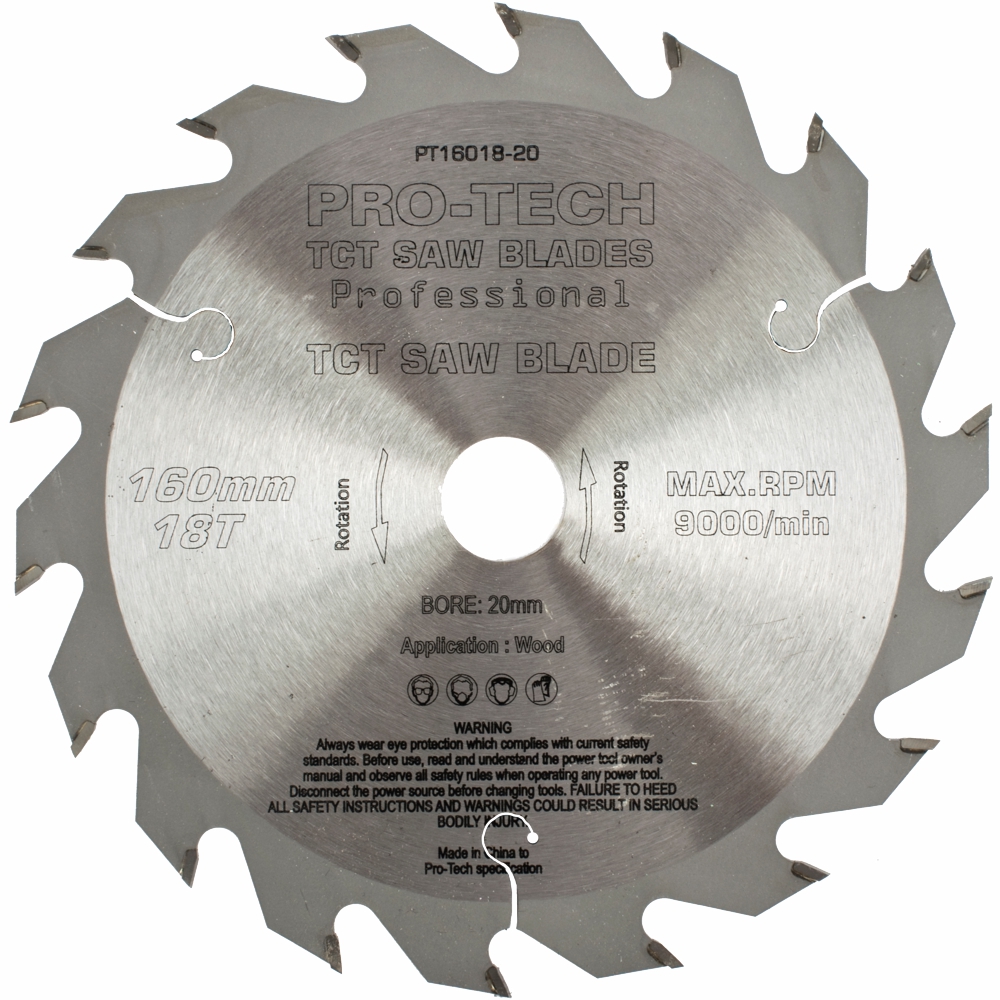
Saw Blade Tct 160X2.2X20X18T Wood Prof. Pro-Tech Fes. Ts55 Pw1
Pro-Tech Saw Blade Tct 160X2.2X20X18T Wood Prof. Pro-Tech Fes. Ts55 Pw1 — clean, accurate cuts with durable carbide-tipped teeth. VAT inclusive.
 Pay over 3 EQUAL zero-interest instalments of R117.98 with PayJustNow.
Or pay over 12 instalments of with PayJustNow.
Find out how...


Your flexible payment provider.
Example payment for
0% interest, zero fees.
28% interest, plus fees.
Total Payment
How does PayJustNow work?


You can complete sign-up in under 2 minutes - no need to leave your cart!
R353.91


The Pro-Tech Saw Blade Tct 160X2.2X20X18T Wood Prof. Pro-Tech Fes. Ts55 Pw1 is engineered for dependable, precise cutting. Because build quality matters, it delivers smooth results and long service life.
Carbide Tipped Saw blade for circular saws - Ripping 160mm x 20mm bore x 18T
High-Performance Circular Saw Blade
Designed for efficient and fast sawing in solid wood and chipboard, this carbide-tipped
circular saw blade is ideal for standard applications. Its cross-cut teeth, made
from high-quality carbide, ensure a smooth and accurate cut.
Key Features:
Carbide-tipped teeth: For exceptional cutting performance.
Alternating teeth: Suitable for both rip cuts and cross
cuts.
Deep chip angle: Efficient waste removal.
Ideal for use with: TS 55 and TSC 55 circular saws.
Compatible materials: Solid wood, chipboard, cement-bonded chipboard,
hardboard, and plasterboard.
Compatibility: This blade is compatible with the following
Festool circular saws models: TS 55, TSC 55, ATF 55, AP 55.
Saw blade terminology
Arbor:
The shaft that turns the saw blade.
ATB:
Alternate Top Bevel. The tips on the saw blade bevels from left to right in
sequence. Each tip has a sharp point that result in a clean, shear cut leaving a
fine finish with minimal chipping. For use in plywood, veneer, particle board
and wood.
Anti-kickback:
The gullet is shaped like a camel's hump, also called a limiter, to limit the
amount of material that can safely be cut by each tooth.
Bore:
The center hole diameter of the saw blade.
Combination:
Circular saw blades that can be used both for crosscutting and ripping.
Crosscut:
A cut made across the grain of the wood. Cutting wood to length.
Dado:
A set of stacked blades designed to produce grooves.
Depth of cut:
The maximum depth of cut safely achievable determined by the power tool
and saw blade diameter.
Diameter:
The outside of the saw blade measured directly accross from one tip to the other
opposing tip.
Expansion slots:
Heat is generated with each cut due to friction. All saw blades have expansion
slots in the body of the blade to have an outlet to release tension and warping.
Flange:
Falnges are used to clamp the saw blade to the arbor of the saw. Most of the
time, the flanges cover more or less a third of the saw blade's diameter. It is
important that the flanges are always clean to prevent warping and vibration.
Flat top grind (FTG):
Unlike the ATB, the tips are ground flat with a 0° top angle. The tips
are more durable and longer lasting. Mostly used with rip saw blades.
Gullet:
The hollowed out shape between teeth that assists with chip clearance. Saw
blades have different gullet designs. Mostly dependant on the material being
cut.
Hollow ground:
The tips are concave shaped.
Hook angle/rake/pitch:
Forward angled tips tend to grab material, like a gouge carving into the
material. Backward angled tips don't have grabbing at all, like a scissor
cutting the material.
Kerf:
The width of cut.
Rip:
A cut made along the grain direction of the wood. Cutting wood to
width.
Shim/bushing:
Depending on the bore of the saw blade and the arbor of the saw. A shim or
bushing is available to adapt the saw blade to the arbor. No bushings or shims
are available in Ø 22.23mm.
TCG:
Triple Chip Grind. A flat top tooth is followed by a trapezoidal tooth. Designed
for saw blades to eliminate chipping in brittle materials like chipboard and
laminated material.
Thin kerf:
The saw blades are slightly narrower than standard saw blades. A lot
less power is needed to make cuts and it has a slightly lower material waste.
Keep in mind to recalibrate the scale on table saws when fitting a thin kerf saw
blade.
Therefore, this model helps you work faster with confidence while maintaining professional standards from start to finish.
Saw Blade Tct 160X2.2X20X18T Wood Prof. Pro-Tech Fes. Ts55 Pw1
Pro-Tech Saw Blade Tct 160X2.2X20X18T Wood Prof. Pro-Tech Fes. Ts55 Pw1 — clean, accurate cuts with durable carbide-tipped teeth. VAT inclusive.
Pay over 3 EQUAL zero-interest instalments of R117.98 with PayJustNow.
Or pay over 12 instalments of with PayJustNow.
Find out how...
Your flexible payment provider.
Example payment for
0% interest, zero fees.
28% interest, plus fees.
Total Payment
How does PayJustNow work?
You can complete sign-up in under 2 minutes - no need to leave your cart!
R353.91
The Pro-Tech Saw Blade Tct 160X2.2X20X18T Wood Prof. Pro-Tech Fes. Ts55 Pw1 is engineered for dependable, precise cutting. Because build quality matters, it delivers smooth results and long service life.
Carbide Tipped Saw blade for circular saws - Ripping 160mm x 20mm bore x 18T
High-Performance Circular Saw Blade
Designed for efficient and fast sawing in solid wood and chipboard, this carbide-tipped
circular saw blade is ideal for standard applications. Its cross-cut teeth, made
from high-quality carbide, ensure a smooth and accurate cut.
Key Features:
Carbide-tipped teeth: For exceptional cutting performance.
Alternating teeth: Suitable for both rip cuts and cross
cuts.
Deep chip angle: Efficient waste removal.
Ideal for use with: TS 55 and TSC 55 circular saws.
Compatible materials: Solid wood, chipboard, cement-bonded chipboard,
hardboard, and plasterboard.
Compatibility: This blade is compatible with the following
Festool circular saws models: TS 55, TSC 55, ATF 55, AP 55.
Saw blade terminology
Arbor:
The shaft that turns the saw blade.
ATB:
Alternate Top Bevel. The tips on the saw blade bevels from left to right in
sequence. Each tip has a sharp point that result in a clean, shear cut leaving a
fine finish with minimal chipping. For use in plywood, veneer, particle board
and wood.
Anti-kickback:
The gullet is shaped like a camel's hump, also called a limiter, to limit the
amount of material that can safely be cut by each tooth.
Bore:
The center hole diameter of the saw blade.
Combination:
Circular saw blades that can be used both for crosscutting and ripping.
Crosscut:
A cut made across the grain of the wood. Cutting wood to length.
Dado:
A set of stacked blades designed to produce grooves.
Depth of cut:
The maximum depth of cut safely achievable determined by the power tool
and saw blade diameter.
Diameter:
The outside of the saw blade measured directly accross from one tip to the other
opposing tip.
Expansion slots:
Heat is generated with each cut due to friction. All saw blades have expansion
slots in the body of the blade to have an outlet to release tension and warping.
Flange:
Falnges are used to clamp the saw blade to the arbor of the saw. Most of the
time, the flanges cover more or less a third of the saw blade's diameter. It is
important that the flanges are always clean to prevent warping and vibration.
Flat top grind (FTG):
Unlike the ATB, the tips are ground flat with a 0° top angle. The tips
are more durable and longer lasting. Mostly used with rip saw blades.
Gullet:
The hollowed out shape between teeth that assists with chip clearance. Saw
blades have different gullet designs. Mostly dependant on the material being
cut.
Hollow ground:
The tips are concave shaped.
Hook angle/rake/pitch:
Forward angled tips tend to grab material, like a gouge carving into the
material. Backward angled tips don't have grabbing at all, like a scissor
cutting the material.
Kerf:
The width of cut.
Rip:
A cut made along the grain direction of the wood. Cutting wood to
width.
Shim/bushing:
Depending on the bore of the saw blade and the arbor of the saw. A shim or
bushing is available to adapt the saw blade to the arbor. No bushings or shims
are available in Ø 22.23mm.
TCG:
Triple Chip Grind. A flat top tooth is followed by a trapezoidal tooth. Designed
for saw blades to eliminate chipping in brittle materials like chipboard and
laminated material.
Thin kerf:
The saw blades are slightly narrower than standard saw blades. A lot
less power is needed to make cuts and it has a slightly lower material waste.
Keep in mind to recalibrate the scale on table saws when fitting a thin kerf saw
blade.
Therefore, this model helps you work faster with confidence while maintaining professional standards from start to finish.