
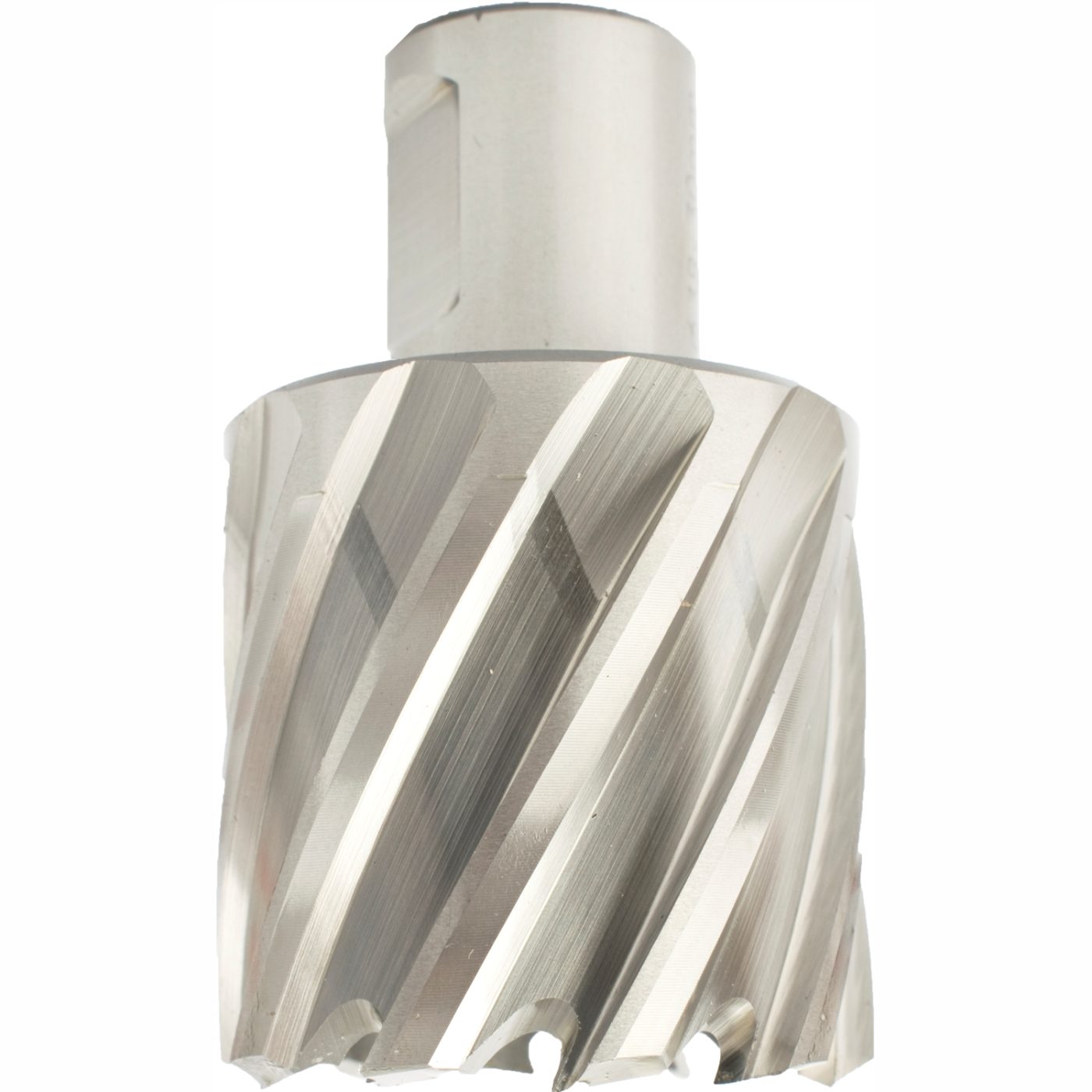
Annular Hole Cutter Hss 42 X 30mm Weld Shank 19.05mm
Annular Cutters 30mm Annular Cutter: Ø42mm One way to avoid dimpling and deburring while making holes in tube and pipe is to use annular cutters.
 Pay over 3 EQUAL zero-interest instalments of R458.09 with PayJustNow.
Or pay over 12 instalments of with PayJustNow.
Find out how...


Your flexible payment provider.
Example payment for
0% interest, zero fees.
28% interest, plus fees.
Total Payment
How does PayJustNow work?


You can complete sign-up in under 2 minutes - no need to leave your cart!
R1,374.25


Because annular cutters are hollow on the inside, there is no dead-zone resistance to overcome. Using a twist drill to make holes in pipe or tubing can prompt concerns about the hole roundness, location accuracy, hole finish, chip extraction, burrs, and drilling duration. The focal point of these concerns is the twist drill's most noticeable feature; its point.
This is not really a point at all, but the tangent line where two cutting angles intersect at the web of the drill, or the so-called 'dead zone.' This dead zone causes the surface speed of the cutting edges to drop to zero.
The lower surface speed reduces cutting efficiency and requires increased thrust, or feed pressure, for the cutting edges to push through the material. Compared to traditional tooling (twist drills, etc.) annular cutters can multiply your cutting speed by up to 3 times while getting a longer tool life, a more accurate hole, a better finish, with no burrs.
The cutting edges distribute the cutting load evenly, thus making it faster cutting. Annular cutters convert a smaller area to chips, requiring less horsepower and thrust. This feature provides longer tool life and less chatter. The slug also offers a higher scrap value than loose chips and shavings. Definition - Annular 'Ring-shaped' or 'forming a ring'. From the latin word annulus
Annular Hole Cutter Hss 42 X 30mm Weld Shank 19.05mm
Annular Cutters 30mm Annular Cutter: Ø42mm One way to avoid dimpling and deburring while making holes in tube and pipe is to use annular cutters.
Pay over 3 EQUAL zero-interest instalments of R458.09 with PayJustNow.
Or pay over 12 instalments of with PayJustNow.
Find out how...
Your flexible payment provider.
Example payment for
0% interest, zero fees.
28% interest, plus fees.
Total Payment
How does PayJustNow work?
You can complete sign-up in under 2 minutes - no need to leave your cart!
R1,374.25
Because annular cutters are hollow on the inside, there is no dead-zone resistance to overcome. Using a twist drill to make holes in pipe or tubing can prompt concerns about the hole roundness, location accuracy, hole finish, chip extraction, burrs, and drilling duration. The focal point of these concerns is the twist drill's most noticeable feature; its point.
This is not really a point at all, but the tangent line where two cutting angles intersect at the web of the drill, or the so-called 'dead zone.' This dead zone causes the surface speed of the cutting edges to drop to zero.
The lower surface speed reduces cutting efficiency and requires increased thrust, or feed pressure, for the cutting edges to push through the material. Compared to traditional tooling (twist drills, etc.) annular cutters can multiply your cutting speed by up to 3 times while getting a longer tool life, a more accurate hole, a better finish, with no burrs.
The cutting edges distribute the cutting load evenly, thus making it faster cutting. Annular cutters convert a smaller area to chips, requiring less horsepower and thrust. This feature provides longer tool life and less chatter. The slug also offers a higher scrap value than loose chips and shavings. Definition - Annular 'Ring-shaped' or 'forming a ring'. From the latin word annulus
Reviews
There are no reviews yet.






Reviews
There are no reviews yet.